Quick Answer
A preventive gate visit should inspect the complete gate system, not just lubricate a hinge and test the remote. The technician should evaluate mechanical movement, operator mounting and drive components, limits/position, power and batteries, access-control inputs, safety devices, manual release, corrosion and site conditions.
The exact checklist must follow the gate and operator manufacturers, but the visit should leave a record of what was inspected, what was tested, what wear was found and what needs attention before the next service.
Begin With the Gate as a Manual Mechanical System
Before blaming the operator, inspect whether the gate moves freely and stays properly supported. Check hinges, rollers, wheels, tracks, racks, chains, guide rollers, stops, posts and structural attachment appropriate to the gate type.
A motor should not be used to pull through a binding mechanical problem.
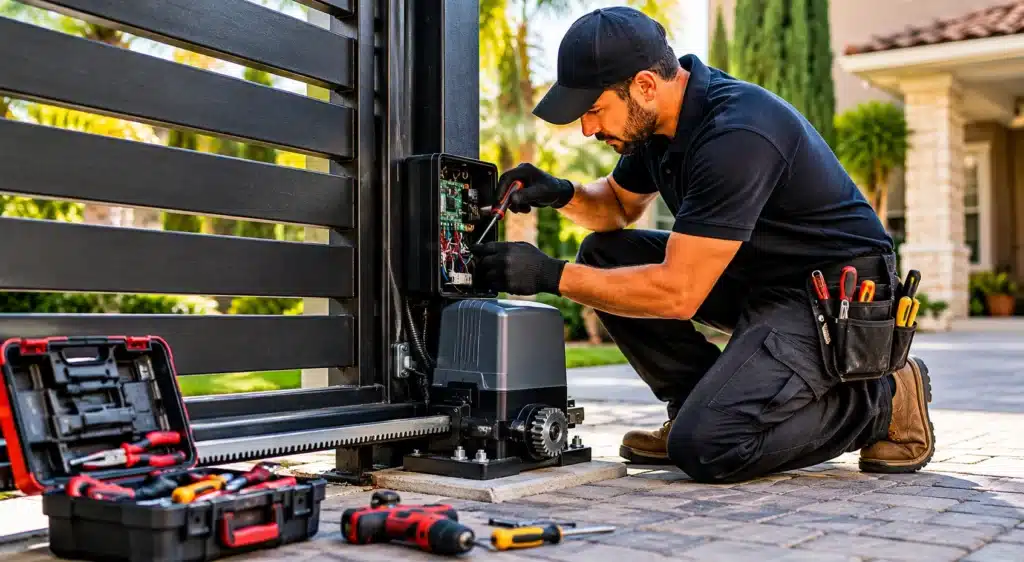
Inspect the Operator and Drive
Review mounting, covers, visible water intrusion, chain or rack condition, arm geometry, gearbox leakage where applicable and any abnormal noise. Compare limit/position operation with the exact operator design.
Fault history and diagnostic logs can reveal intermittent problems that do not appear during a single cycle.
Check Power and Backup
Inspect supply condition within the technician’s scope, low-voltage connections, charging system and batteries according to manufacturer instructions. For solar systems, review panel condition, controller diagnostics and whether the site load still matches the design.
A preventive visit should identify weak backup before an outage does.
Test Entrapment Protection
Photo eyes, sensing edges and other monitored devices need functional verification, not just visual inspection. Confirm mounting and wiring, then perform the operator’s prescribed tests.
Do not treat vehicle loops as a universal substitute for required entrapment protection.
Check Access-Control Inputs
Keypads, remotes, intercoms, card readers, timers and network controllers can create gate commands even when the operator itself is healthy. Confirm that intended access inputs work and that unintended or abandoned inputs are not creating mystery behavior.
Commercial sites should also review credential and schedule administration separately from mechanical service.
Inspect Manual Release and Emergency Access
The release mechanism should be accessible, identifiable and operable as intended. Staff or owners should know the safe procedure for the actual gate.
For sites with fire-department or other emergency-access requirements, verify the approved equipment and local procedure without assuming one jurisdiction’s rule applies everywhere.
Document Findings and Priorities
A strong maintenance report separates immediate safety issues, reliability repairs, monitor items and future capital planning. Photos and model/serial information improve continuity between visits.
The report should make it clear whether the gate was returned to normal automatic service and whether any limitation remains.
The Visit Should Separate Safety, Reliability and Capital Items
A useful preventive report should not put every finding in one undifferentiated list. Immediate safety defects need fast correction. Reliability items may justify scheduled repair. Capital items such as an obsolete operator can be planned over a longer horizon.
This prioritization helps property managers budget without losing sight of urgent conditions.
Common Mistake: Calling a Visual Check a Safety Test
A clean photo eye and intact edge can still fail electrically or be misconfigured. Where the operator manufacturer specifies functional tests, those tests should be performed and recorded.
Visual condition and functional response are two different maintenance tasks.
Example: Maintenance Finds the Cause Before Failure
A sliding gate still operates normally, but a preventive visit finds increasing wheel bearing play and rack mesh becoming tight in one section. Correcting the wheel/alignment prevents rising operator load and potential gearbox damage.
That is the value of preventive service: finding a developing mechanical issue before the owner reports a dead gate.
A Maintenance Visit Should Follow the Gate’s Architecture
The checklist for a sliding gate is not identical to the checklist for a swing gate. A tracked slide system may need wheel, track and rack inspection, while a swing system depends heavily on hinges, posts and operator geometry.
The technician should also inspect the access-control and safety devices connected to the operator.
This keeps maintenance from becoming a generic "lubricate and leave" visit.
Close the Visit With Functional Testing
After adjustments or lubrication, cycle the gate through normal operation and verify limits, movement, safety inputs and manual release.
If batteries or charging are part of the system, confirm their condition under the manufacturer’s procedure. If a loop or photo eye was adjusted, verify the controller responds correctly.
The service report should state what was inspected, what was changed and what developing issues should be monitored next.
Maintenance Should Identify Safety Devices by Name
The service report should state which photo eyes, edges, loops or other devices were inspected. Generic language such as "safety checked" is less useful for future troubleshooting.
Bottom Line
Preventive maintenance should cover mechanics, operator, power, backup, safety devices, access controls, manual release and site conditions as one system. The value is not the checklist itself but finding rising risk before it becomes a breakdown or safety event.