Quick Answer
An automatic gate should be maintained as a safety system, not as a motor attached to a fence. Safe operation depends on the condition of the gate, operator, monitored photo eyes or sensing edges, wiring, controls, manual release and the actual travel path used by vehicles and people. UL 325 provides the operator-safety framework, while ASTM F2200 covers automated-gate construction. Maintenance therefore has to verify the installed protection system and the physical gate together.
Owners should never bypass a monitored photo eye, sensing edge or reversing system to keep a gate operating. Manufacturer instructions commonly require regular owner testing and qualified service when a malfunction is observed. A gate that has unpredictable movement, failed safety devices, damaged hardware, exposed wiring or repeated electrical faults should be taken out of normal automatic service until the problem is corrected.
Preventive maintenance is more than lubrication. It includes gate alignment, hinges or rollers, drive components, batteries, limits, wiring, safety-device testing, manual release and access-control function.
In this guide
- Why automatic gates require a safety-system mindset
- UL 325 and ASTM F2200: what each one does
- Usage classification changes the safety environment
- Entrapment zones must be identified, not guessed
- Photo eyes, sensing edges and inherent reversing systems
- Vehicle loops are not a substitute for entrapment protection
- Why a gate may only move while a button is held
- Emergency access is part of gate safety planning
- Monthly owner testing and manufacturer schedules
- What preventive maintenance should include
- Safe servicing requires control of stored and unexpected energy
- Maintenance interval should follow use and environment
- Photo-eye problems in rain, fog and irrigation
- Heat, batteries and power quality
- Manual release and power-outage readiness
- Pedestrians and automatic vehicular gates
- Children, pets and pedestrians are predictable exposure, not edge cases
- Control placement matters
- Warning signs and owner training
- After a safety event, do not just reset and continue
- When an older operator should be replaced for safety reasons
- What a preventive-maintenance report should document
- A practical safety example
- Related Royal Gates resources
Why automatic gates require a safety-system mindset
A vehicular gate can be large, heavy and capable of producing significant force. Safe operation therefore depends on more than whether the gate opens and closes.
DASMA identifies several recurring hazards in automated gate systems, including people using the vehicular gate as a pedestrian path, exposed rollers and pinch points, unsafe control placement, missing entrapment protection, physical gate failure and untrained attempts to adjust or repair the system.
The safest approach is to treat the installation as one system with three layers:
- Safe gate construction and physical geometry.
- A listed operator with appropriate monitored entrapment protection.
- Safe use, inspection and maintenance over the life of the system.
A strong operator cannot make an unsafe gate safe by itself. A well-built gate is not safe if required protection devices are missing or defeated. Good maintenance preserves both layers.
UL 325 and ASTM F2200: what each one does
These two standards are often mentioned together, but they address different parts of the automated gate system.
UL 325
UL 325 is the safety standard used for automatic gate operators and related systems. It addresses hazards including entrapment and defines requirements for operator behavior and protection devices.
UL and major operator manufacturers explain that modern vehicular gate installations require independent entrapment-protection methods in identified hazard zones. Depending on the gate and operator, protection may include an inherent reversing system plus monitored external photoelectric or edge sensors.
The operator manufacturer’s current installation manual controls the exact number, type and connection of protection devices for that model and gate geometry.
ASTM F2200
ASTM F2200 addresses automated vehicular gate construction. DASMA guidance highlights physical issues such as openings in slide gates, exposed rollers, fall-over protection, pinch points and the relationship between the gate and adjacent structures.
The practical distinction is simple: UL 325 focuses on the operator and operating system; ASTM F2200 focuses on the gate that the operator moves.
A safe installation needs both sides of the equation.
Usage classification changes the safety environment
Automatic vehicular gate operators are assigned UL 325 usage classifications based on the environment in which they are intended to operate.
Class I covers residential garages or parking areas associated with one-to-four-family residences. Class II covers commercial and public-facing locations such as multifamily housing, hotels, public garages and retail properties. Class III covers industrial locations not intended to serve the general public. Class IV covers guarded restricted-access locations where unauthorized access is prevented by security supervision.
The classification does not replace a site-specific hazard review. It helps establish the kind of environment and users the operator is intended to serve. A gate at a single-family residence, an apartment entrance and a guarded industrial site can expose very different populations to the moving gate.
When replacing an operator, confirm that the new model is listed for the site's applicable usage classification rather than assuming that higher horsepower or heavier construction automatically makes it appropriate.
Entrapment zones must be identified, not guessed
An entrapment zone is a location where a person could be caught between the moving gate and a fixed object or within the gate mechanism.
Common examples include:
- The closing edge of a swing gate approaching a wall or post.
- The area behind a sliding gate as it moves parallel to a fence.
- Openings in a slide gate that pass a stationary structure.
- Exposed rollers or drive mechanisms.
- Areas where a gate leaf approaches a fixed object during opening.
Every installation is different. A device mounted in the wrong place can leave a real hazard unprotected even if the system technically “has photo eyes.” Safety design should begin with the actual movement path and the operator manufacturer’s entrapment-zone instructions.
Photo eyes, sensing edges and inherent reversing systems
Monitored photoelectric sensors
A photo eye creates a non-contact detection zone. When the beam is interrupted, the operator responds according to its safety logic.
Modern monitored devices also communicate their operational status to the operator. If the device is disconnected or fails its monitoring circuit, the operator can restrict normal automatic movement instead of silently operating without protection.
Photo eyes must be properly located, aligned, wired and protected from physical damage. Water spray, corrosion, dirty lenses, vibration or movement of mounting posts can create intermittent faults.
Sensing edges
A sensing edge is a contact device mounted where the moving gate could contact an obstruction. When activated, it signals the operator to stop or reverse as required by the system.
Edges should be inspected for physical damage, cracked housings, damaged wiring and correct mounting. An edge that has been crushed, cut or disconnected is not reliable simply because the gate still moves.
Inherent reversing protection
Many operators include built-in obstruction sensing based on force, current, speed or other operator behavior. This is an important protection layer, but it does not eliminate the need for required external monitored devices in applicable entrapment zones.
Force settings should never be increased merely to make a binding gate move. Mechanical drag should be corrected first.
Vehicle loops are not a substitute for entrapment protection
Inductive loops are commonly installed in driveways to detect vehicles. Depending on the system, they may open the gate, hold it open, provide free exit, protect a vehicle path or support shadow-loop logic.
A loop is a traffic-detection tool. It should not be assumed to satisfy the operator’s required entrapment-protection configuration. The operator manual defines which safety devices are required and which loop inputs serve vehicle-control functions.
This distinction matters because a system can detect cars reliably while still leaving a pedestrian entrapment zone unprotected.
Why a gate may only move while a button is held
When a monitored safety device fails, some operators restrict normal automatic operation. UL guidance explains that where required external entrapment protection is not functioning, the operator may be limited to constant-pressure operation instead of normal unattended travel.
That behavior is a warning, not a convenient alternate mode.
If a gate suddenly requires continuous pressure to move, check the operator diagnostics and monitored safety devices. Do not jumper the failed input to restore remote operation.
Emergency access is part of gate safety planning
Emergency access should be designed before an emergency occurs.
DASMA guidance treats emergency access as part of the automated vehicular gate system and recognizes both powered emergency-access systems and mechanical emergency-release approaches, subject to the requirements of the local authority having jurisdiction.
For properties where fire-department or other emergency access requirements apply, the gate system should be designed, documented and tested for that approved method. The owner or property manager should know which device provides emergency entry, what happens during power failure, and who is responsible for keeping the system operational.
Emergency-access rules vary by jurisdiction and property type. A requirement that applies to an LAFD-regulated private street, access road or fire lane should not be presented as a universal rule for every residential driveway gate.
Monthly owner testing and manufacturer schedules
Maintenance frequency is model-specific, but major manufacturer documentation commonly calls for recurring safety checks. LiftMaster owner instructions for current vehicular gate operators include monthly testing of the gate operator and entrapment-protection response. DoorKing manuals also publish monthly checklists for many models.
A practical owner-level monthly review can include manufacturer-approved checks such as:
- Observe a full open and close cycle from a safe location.
- Listen for new grinding, scraping or impact sounds.
- Confirm the gate does not sway, drag or strike fixed objects.
- Inspect warning signs.
- Look for obvious damage to photo eyes and sensing edges.
- Test entrapment protection exactly as described in the operator manual.
- Confirm the manual release is accessible and understood.
- Look for exposed or damaged wiring without opening live electrical compartments.
If a safety test fails, take the gate out of normal automatic service until the cause is corrected.
What preventive maintenance should include
Professional preventive maintenance should cover the physical gate and the operator together.
Gate structure and movement
Check hinges, rollers, wheels, tracks, brackets, fasteners, welds, physical stops and alignment. The gate should move freely and remain properly supported throughout travel.
A slide gate should not be at risk of falling if a roller fails. Exposed rollers and pinch points should be guarded as required. Swing gates should not sag or contact the ground.
Drive system
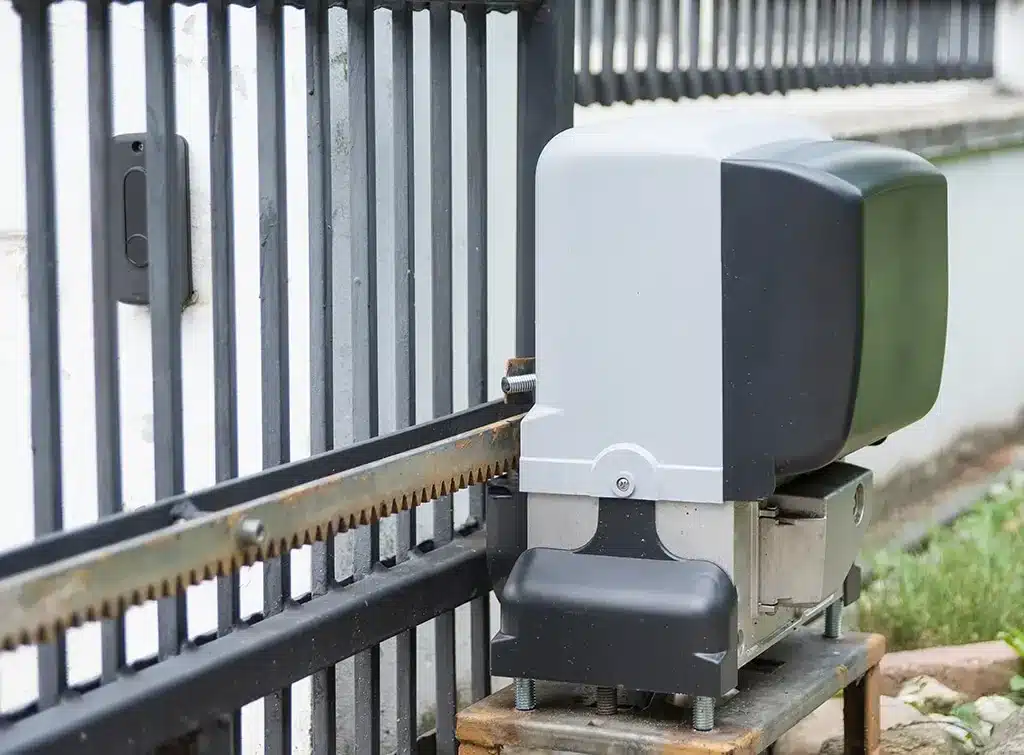
Inspect chains, belts, sprockets, arms, couplings, gearboxes and mounting hardware. Look for wear, looseness, misalignment, oil leakage where applicable and abnormal noise.
Electrical system
Check accessible wiring, terminals, conduit, enclosures and signs of water intrusion, heat or corrosion. Battery and charging systems should be tested under appropriate load rather than judged only by appearance.
Limits and position
Verify that the gate reaches the intended open and closed positions without slamming into physical stops or continuing to drive unnecessarily.
Entrapment protection
Test inherent reversal and each monitored external safety device according to the manufacturer’s procedure. If a device cannot be made operational, the gate should not be returned to normal automatic service.
Access control
Confirm remotes, keypads, intercoms and access-control relays operate without bypassing the operator’s normal safety logic.
Manual release
Verify that the manual release can be used as instructed when the gate is stopped. The property owner or manager should know where the release is and who is authorized to use it.
Safe servicing requires control of stored and unexpected energy
Automatic gates can move from electrical, mechanical, hydraulic or stored energy. Servicing a system can expose a technician to unexpected movement even when a normal remote is not being used.
For employees performing covered servicing and maintenance, OSHA's control-of-hazardous-energy requirements may apply when unexpected energization, startup or release of stored energy could cause injury. Professional service procedures should therefore include the appropriate energy-isolation practices for the equipment and work being performed.
Property owners should not open live electrical compartments, work inside hydraulic systems, defeat interlocks or place themselves in the gate's travel path to diagnose a fault. Owner-level inspection should remain limited to the checks authorized in the manufacturer's instructions.
Maintenance interval should follow use and environment
There is no useful one-size-fits-all service interval for every automatic gate. Start with the operator manufacturer’s required inspection schedule, then shorten the interval when the site has heavier use, corrosive exposure, repeated debris, irrigation overspray, heat, vibration or a history of component failures. A service plan should reflect the condition of the actual system rather than a generic calendar reminder.
Environmental exposure also changes the maintenance need. Coastal air can accelerate corrosion. Irrigation overspray can affect electronics and sensors. Dust can collect in slide tracks and enclosures. Heat can shorten battery life and increase electrical stress.
The correct maintenance plan combines the manufacturer’s minimum schedule with actual cycle demand and site conditions.
Avoid rigid universal claims such as “every gate needs service every six months.” Some systems may need more frequent inspection; others may have different manufacturer schedules.
Photo-eye problems in rain, fog and irrigation
A safety sensor that fails during wet weather should not be treated as an unavoidable inconvenience.
Possible causes include:
- Water on or inside the sensor housing.
- Damaged seals.
- Corroded terminals.
- Poorly protected wiring splices.
- Mounting movement that changes alignment.
- Direct irrigation spray.
- Dirty lenses that become more problematic when wet.
Some commercial photo eyes use enclosures specifically designed to resist direct water spray and corrosion. Even then, correct installation, cable protection and alignment remain important.
If the gate repeatedly stops closing after rain, document which sensor shows a fault and inspect the water path. Repeated resets without repair allow corrosion to progress.
Heat, batteries and power quality
Batteries are one of the most overlooked gate maintenance items. A battery may work during normal AC power but fail to support the gate during an outage. Heat can accelerate battery aging, and repeated deep discharge can shorten life.
Maintenance should verify battery condition, charger operation and connections. On solar systems, inspect panel condition, wiring, shade and charging performance.
Repeated breaker trips, burning smells, discolored wiring or hot electrical components require professional attention. Resetting a breaker over and over is not preventive maintenance.
Manual release and power-outage readiness
Every property should know how the gate can be operated if normal power or controls fail.
The manual-release procedure differs by operator. Some systems use a key release, lever, clutch or foot-pedal mechanism. Manufacturer instructions should be kept where property managers or owners can access them.
The release should generally be used while the gate is stopped. A moving gate should never be approached simply because power has failed.
For multi-user or commercial properties, decide who has access to the release and how security will be maintained if the gate must remain open temporarily.
Where a site is subject to fire-department access requirements, emergency override and fail-safe behavior should be tested as required by the applicable authority.
Pedestrians and automatic vehicular gates
A vehicular gate opening should not double as the normal pedestrian path. DASMA safety guidance warns against pedestrian use of automated vehicular gate systems and recommends separate controlled pedestrian access.
This matters especially at apartment buildings, schools and homes where children may walk near the driveway.
A separate pedestrian gate allows the vehicular operator to be designed for vehicles without encouraging people to enter the gate’s travel path or reach through the gate to operate controls.
Children, pets and pedestrians are predictable exposure, not edge cases
An automatic vehicular gate is designed to control vehicles. It should not become the normal pedestrian entrance.
Children may treat a moving gate as something to ride, climb or race. Pets can enter a closing path below the driver's sight line. Delivery workers or visitors may follow a vehicle through an opening because there is no obvious pedestrian route.
Safety planning should therefore include a separate pedestrian access point, visible warning signs, control placement away from moving parts and a property rule that people do not walk through or play around the vehicular gate.
Entrapment protection reduces risk, but it is not a substitute for keeping people out of the gate's operating zone.
Control placement matters
Controls should be positioned so a user cannot reach through or stand in the gate’s moving path while operating the system. DASMA and manufacturer checklists address maintaining separation between user controls and the moving vehicular gate.
A keypad placed too close to the gate can create a situation where someone reaches through the gate or stands in an entrapment zone to enter a code. Good placement considers both vehicle convenience and human safety.
Warning signs and owner training
Warning signs are part of the system. They should be visible from both sides where required and kept readable.
Owner training should cover:
- Normal operation.
- Meaning of common fault indicators.
- Safety-device locations.
- How to perform approved safety tests.
- Manual release.
- What not to bypass.
- Who to call for repair.
- How to keep children and pedestrians away from the moving vehicular gate.
A gate owner should not receive a newly automated system without understanding how it behaves when something goes wrong.
After a safety event, do not just reset and continue
A reversal, entrapment-device activation, collision or unusual stop is diagnostic information.
If the gate contacted a vehicle or object, reversed unexpectedly, damaged a safety device, or required a reset after repeated obstruction events, inspect the reason before returning it to normal service. The event may have changed gate alignment, damaged wiring, moved a photo eye, deformed an edge sensor or affected limit settings.
For a significant event, document what happened, which direction the gate was moving, which safety device activated, whether there was physical contact, and what repair or inspection followed. Repeatedly resetting the system without finding the cause can turn an early warning into a later failure.
A gate involved in an injury or suspected entrapment event should be kept out of normal automatic service until the system has been appropriately inspected and the property has addressed any required incident or safety procedures.
When an older operator should be replaced for safety reasons
Age alone is not the only factor, but older systems deserve a safety review.
DASMA’s inspection checklist notes that gate operators manufactured before March 2000 may lack adequate modern safety provisions and flags them for evaluation or replacement by a trained gate systems technician. LiftMaster also points to improved entrapment protection and modern safety technology as reasons to consider replacing old operators.
Replacement becomes more compelling when the operator cannot support current monitored safety devices, when critical parts are obsolete, or when the gate itself cannot be brought into a safe automated configuration without substantial work.
What a preventive-maintenance report should document
A professional maintenance visit should produce a useful record, especially for HOAs, commercial properties and high-cycle systems.
The report should identify:
- Gate condition.
- Operator model.
- Safety devices tested.
- Failures or corrections made.
- Battery condition.
- Drive wear.
- Limit/position condition.
- Access-control issues.
- Manual-release function.
- Any deferred repairs.
- Any safety-related reason the gate should remain out of service.
- Recommended next inspection based on manufacturer guidance and site use.
This history helps separate recurring failures from isolated problems and supports repair-versus-replacement decisions later.
A practical safety example
Imagine a sliding gate that still opens normally but will not close from a remote. A property manager discovers that holding a local button makes the gate move and considers bypassing the photo eye so residents can use the gate again.
The restricted control behavior may be the operator protecting against a monitored safety-device fault. Bypassing the device would remove the protection that caused the operator to restrict normal movement.
The correct response is to identify whether the photo eye is blocked, misaligned, water-damaged, disconnected or incompatible, repair the fault, verify all required protection devices, and only then restore normal remote operation.
The system is not “broken because it is too safe.” The restricted behavior is part of the diagnostic evidence.
Pro Tip: keep the exact operator manual with the property records
Gate safety requirements and maintenance procedures vary by operator model. Keep the exact installation/owner manual, model and serial information, access-control documentation and service history together. That makes troubleshooting faster and prevents a future technician from relying on a generic manual for a different model.
Related Royal Gates resources
Bottom Line
Automatic gate safety is a lifecycle responsibility. A safe installation can become unsafe when rollers wear, hinges sag, photo eyes are bypassed, warning signs disappear, batteries fail or controls are moved into hazardous locations.
Use UL 325 and ASTM F2200 as the technical framework, but follow the current operator manufacturer’s instructions for the exact installation. Test monitored safety devices on the required schedule. Keep pedestrians out of the vehicular gate path. Maintain the gate hardware as carefully as the electronics. If entrapment protection, structure or electrical safety is compromised, do not keep the gate in normal automatic service until it is corrected.
A safe automatic gate remains safe only when the physical gate, operator, entrapment protection, controls and maintenance practices continue to work together over time.
Frequently Asked Questions
What is UL 325 for automatic gates?
UL 325 is the safety standard used for automatic gate operators and systems. It addresses hazards including entrapment and requirements for operator safety behavior and protection devices.
What is ASTM F2200?
ASTM F2200 addresses construction requirements for automated vehicular gates, including physical hazards such as openings, rollers, support and entrapment areas.
How many safety devices does an automatic gate need?
The exact requirement depends on the operator and identified entrapment zones. Modern UL 325 guidance calls for independent protection methods in applicable zones. Follow the current manufacturer manual for the specific operator and installation.
Are photo eyes required on every automatic gate?
Many modern systems require monitored external protection, often photo eyes and/or sensing edges, depending on the gate and entrapment zones. The operator manual defines the required configuration.
Why does my gate only move when I hold the button?
The operator may be in a restricted constant-pressure mode because a monitored safety device has failed or is missing. Check diagnostics and repair the protection device rather than bypassing it.
How often should I test an automatic gate?
Follow the manufacturer’s owner manual. Major manufacturers commonly call for recurring, often monthly, safety testing of the operator and entrapment-protection response.
Can a vehicle loop replace a photo eye?
No assumption should be made that it can. Vehicle loops and monitored entrapment-protection devices serve different functions. Follow the operator manufacturer’s required safety configuration.
Should an automatic driveway gate have a separate pedestrian gate?
Yes, separate pedestrian access is the safer design and avoids encouraging people to walk through the moving vehicular gate path.
When should an old gate operator be replaced?
Replacement should be considered when safety-device compatibility is inadequate, critical parts are obsolete, the operator is incorrectly sized, failures are recurring, or the system cannot be brought into a safe modern configuration.