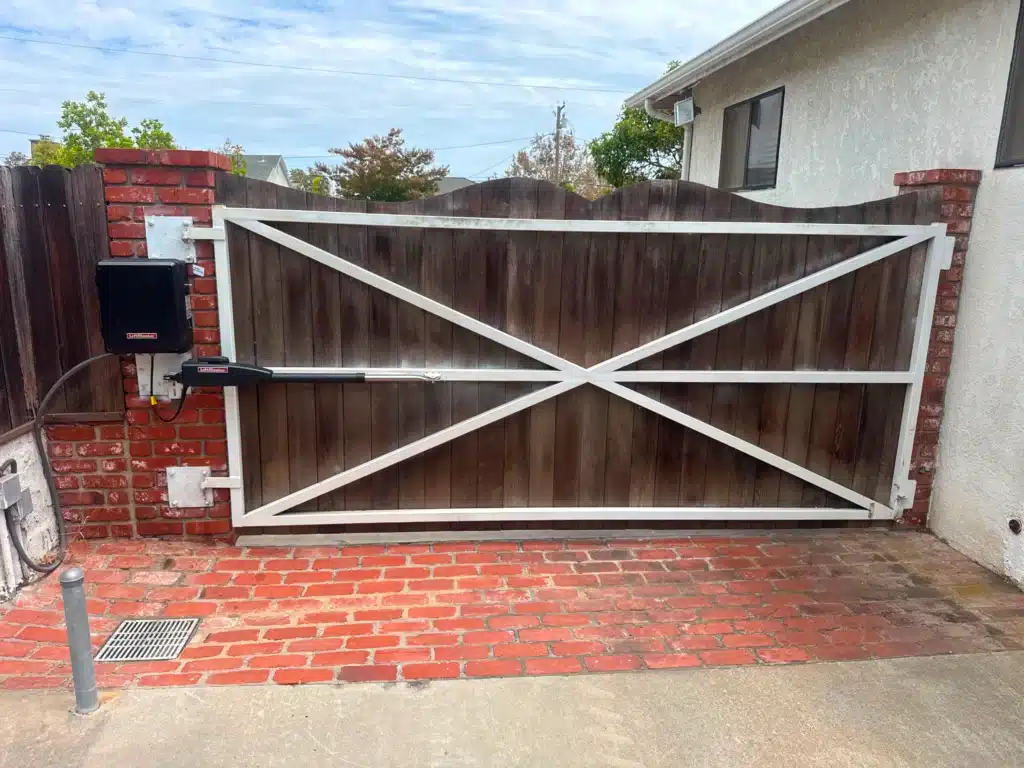
Quick Answer
A gate that stops halfway can be reacting to mechanical resistance, a limit or encoder problem, weak power, thermal protection, safety inputs or an operator fault. The fact that it stops at a repeatable position is especially useful.
If the stop point is always the same, inspect what happens physically and electronically at that location. If the stop point changes, power, heat or intermittent control faults become stronger suspects.
Repeatable Position Suggests Geometry or Position Sensing
A slide gate may bind at a damaged track section or rack joint. A swing gate may drag as its geometry changes through the arc. A magnetic limit or encoder can also misreport position at a consistent point.
Variable Stop Points Suggest a Different Fault Family
If the gate stops in different locations, look at battery condition, voltage under load, motor temperature, intermittent wiring or controller faults.
Record whether the gate restarts immediately or only after waiting.
Mechanical Resistance Should Be Checked First
The operator should not be used to muscle through a dragging wheel, sagging hinge or bent track. Manual movement, when safe and performed according to the release instructions, can reveal resistance.
Weak Batteries Can Fail Under Load
A battery may show acceptable open-circuit voltage but collapse when the motor draws current. This can create partial travel and then a stop.
Manufacturer load-testing procedures are more useful than a single voltage reading.
Heat and Duty Cycle Matter
A gate that travels fully when cold but stops after repeated cycles may be exposing thermal limits or a mechanical load that becomes more significant under frequent use.
Safety Inputs Can Interrupt Travel
A photo eye, sensing edge or detector may activate only when the gate reaches a certain area. Check device status and wiring while reproducing the fault safely.
Do Not Reset Away the Evidence
Fault codes and event history can reveal obstruction, limit, overcurrent or safety-device events. Record them before repeated power cycling clears useful information.
Use the Stop Location as Diagnostic Data
Measure or mark where the gate stops. If it stops within inches of the same location every time, inspect the physical path and the position-sensing system around that area. On a slide gate, look for track damage, rack misalignment, guide interference or a shifted magnet. On a swing gate, inspect ground clearance and arm geometry as the leaf approaches that angle.
If the stop point changes, the technician should look more closely at power, heat, intermittent wiring and controller faults.
Compare the First Cycle With Later Cycles
A gate that completes the first cold cycle but stops halfway after several openings may be revealing a thermal or battery issue. A gate that stops halfway after an overnight outage may have weak backup batteries or incomplete charging. A gate that stops only in high wind may be exposing an application or mechanical-load problem.
The operating history around the failure is part of the evidence, not background noise.
Common Mistake: Adjusting Limits Before Checking Mechanics
If the gate physically binds, moving the limit does not solve the resistance. Similarly, if the limit sensor has shifted, increasing motor force does not restore position accuracy.
The correct order is to confirm the gate can move through its intended path, then confirm the position system reports that path correctly.
What the Technician Should Document
A useful service note should record the stop location, operator fault code, battery or supply behavior under load, manual gate resistance, and any limit/encoder findings. If the fault was intermittent, note the conditions under which it was reproduced.
That record makes future troubleshooting much more efficient if the symptom returns.
Example: Two Halfway Stops With Different Causes
A sliding gate stops at the same point every morning. Manual inspection finds a damaged section of track that becomes tight as the gate weight crosses it. The operator is protecting itself from the increased load. The fix is mechanical.
A second gate stops at different positions after several busy cycles. Its fault log shows low battery voltage and overcurrent events. After the charging system is repaired and the gate resistance is checked, full travel returns.
Both owners describe "stops halfway," but the evidence points to different systems. That is why the stop location, cycle history and fault code should be collected together.
When a Halfway Stop Should End Owner Testing
If the gate jerks, leans, comes off a guide, makes a new grinding sound or becomes difficult to move manually, stop cycling it. Likewise, if the operator repeatedly reports a safety or overcurrent fault, do not keep resetting it.
A controlled service diagnosis is safer and usually faster than continuing to reproduce a fault that may be adding mechanical or electrical stress.
Bottom Line
A halfway stop is a pattern, not a diagnosis. Compare whether the stop point is fixed or variable, then evaluate mechanical resistance, position sensing, power, heat and safety inputs without forcing the gate.