Quick Answer
A solid privacy gate can experience much higher wind forces than an open ornamental gate because the full surface acts like a sail. That affects the frame, hinges or rollers, posts, foundations, operator and stops. Gate weight alone is not enough to select an operator or structure.
The design should consider gate area, local exposure, opening width, material, frame stiffness, support conditions and how wind acts when the gate is closed, opening and fully open.
Why Solid Gates Behave Differently
Wind pressure acts across the surface of the gate.
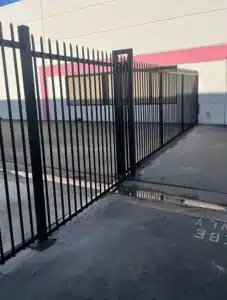
An open picket or ornamental gate allows much of the air to pass through. A solid wood, metal or composite gate blocks it.
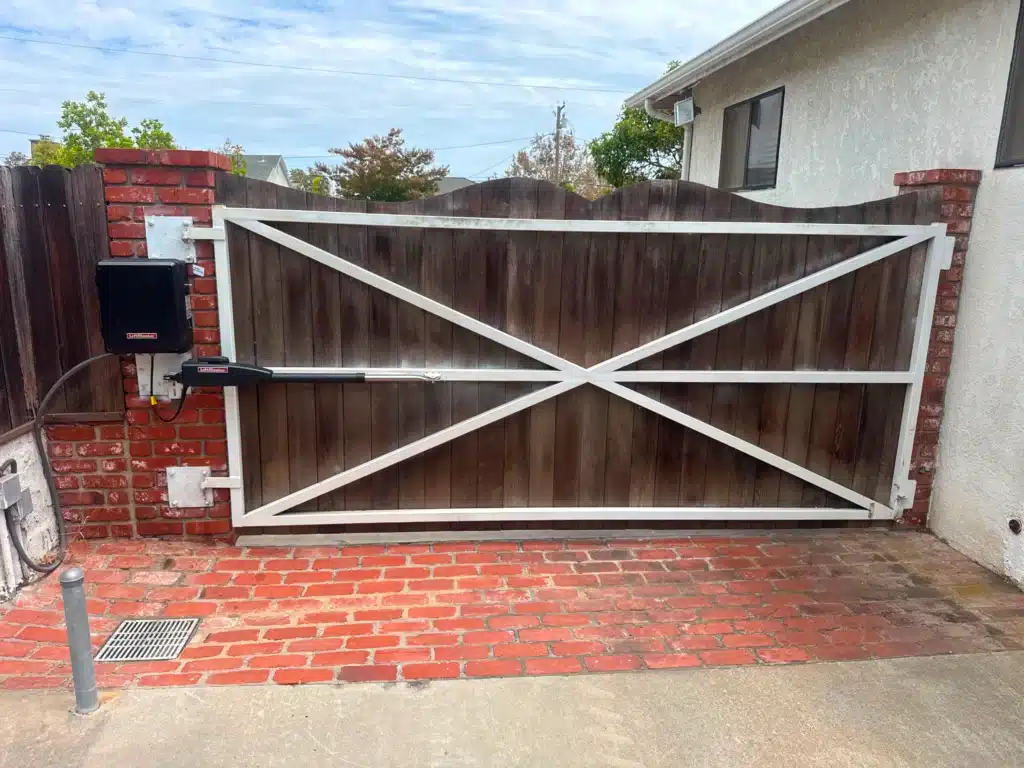
For a swing gate, wind creates torque around the hinge line. The farther the wind force acts from the hinges, the larger the leverage.
For a sliding gate, wind can push the gate sideways against guides and support hardware and can affect operator loads during movement.
Weight and Wind Are Separate Loads
A gate can be light and still be difficult in wind.
For example, a thin aluminum privacy panel may weigh less than a heavy ornamental steel gate but present far more wind area.
This is why "the operator is rated for X pounds" is not enough information for a large privacy gate.
Manufacturer application guidance may also limit gate length or require consideration of wind loading.
Posts and Foundations for Privacy Gates
A swing-gate post resists more than the gate’s static weight.
It also sees:
- hinge moment from the gate span;
- operator forces;
- repeated opening cycles;
- wind torque;
- impact or stop loads.
A solid long leaf can magnify all of these.
Sliding systems shift the support loads, but guide posts and cantilever supports can also see high wind forces.
Foundation design should match actual site conditions. Do not copy a generic footing dimension without considering soil, gate size and exposure.
Frame Stiffness
A privacy gate frame should resist both sagging and twisting.
Common frame concerns include:
- insufficient tube depth;
- long unsupported spans;
- weak corner joints;
- infill fastened in a way that distorts the frame;
- lack of diagonal bracing where needed.
Wind can rack the frame even if the gate does not visibly sag under gravity.
Operator Stress in Wind
An automatic operator should not be used as a structural brace.
Strong wind can make a swing gate difficult to start, stop or hold. An operator near the edge of its application may show intermittent force faults or excessive wear.
For safety, do not simply increase force settings to overpower wind. The gate and operator should be designed for the environment.
Consider Permeable Privacy Designs
Privacy does not always require a fully solid panel.
Alternatives can include:
- spaced slats;
- louvers;
- perforated panels;
- partially open lower/upper sections;
- landscape screening placed separately from the gate.
These approaches can reduce wind area while preserving visual screening.
The tradeoff is that privacy, security and aesthetics may change.
Gate Position Matters
A gate can see different wind loads in different positions.
A closed swing gate may be sheltered by a wall or fence. As it opens, the leaf may move into an exposed orientation. The operator must control movement through the entire cycle.
Similarly, a sliding gate may emerge from behind a wall into an exposed opening.
Site observation during common wind conditions is useful.
Warning Signs That Wind Is Already a Problem
Look for:
- gate leaves visibly flexing;
- posts moving;
- hinges loosening;
- operators stalling only on windy days;
- latch misalignment;
- guide rollers showing side wear;
- weld cracks;
- repeated limit/position faults after wind events;
- privacy panels pulling away from frames.
These are signs to inspect the structure, not simply recalibrate the operator.
Retrofitting Solid Infill to an Existing Gate
This should be treated as a design change.
Before adding panels:
- calculate or estimate the new finished weight;
- evaluate added wind area;
- inspect frame stiffness;
- confirm post/foundation capacity;
- review hinges or support rollers;
- confirm the operator remains appropriate;
- reposition safety devices if the new infill changes accessible areas.
Do not assume an operator suitable for an open gate remains suitable for the solid version.
Questions for a Privacy-Gate Proposal
Ask:
- What is the finished gate area and weight?
- How is wind exposure considered?
- Is the frame designed for torsion and sag?
- What post/foundation is specified?
- Is the operator approved for the gate length and application?
- How does the infill attach?
- Can wind pass through any part of the design?
- What maintenance is required after storms or high-wind events?
Privacy Infill Can Change Operator Selection Later
If a gate is being designed in stages, size posts, hinges and automation for the final solid-infill condition. Adding privacy panels after installation can materially change wind load and operator demand.
Bottom Line
Solid privacy gates can be excellent automated gates, but they should be designed as wind-loaded structures, not just heavier versions of ornamental gates.
When the gate catches wind, the entire system feels it. Frame, posts, foundations, hardware and operator need to be selected together.