Security technology for residential and commercial gates has advanced considerably over the past decade. Today, a fingerprint smart lock represents one of the most meaningful upgrades a property owner can make to their gate. At Royal Garage Door & Gate Services INC, the team works with homeowners and businesses across Los Angeles to modernize gate access and strengthen property security. It replaces traditional keys and codes with biometric authentication that is more secure and more practical for daily use.
What Is a Fingerprint Smart Lock and How Does It Work on a Gate?
A fingerprint smart lock is a biometric access device. Specifically, it reads the unique ridge pattern of a registered fingerprint and uses that data to grant or deny entry. Once mounted on a gate, it replaces or supplements traditional locking systems. These include keypads, key cylinders, and remote-controlled gate releases.
Inside the lock, a sensor captures a fingerprint image. It then compares that image against a stored database of registered prints within milliseconds. When the sensor confirms a match, the lock signals the gate to release or triggers the gate motor to open. When the sensor finds no match, the system denies entry. In addition, on most models, it logs an alert or activates an alarm.
Most gate-rated fingerprint smart locks also include backup access options. For instance, a PIN keypad or physical key cylinder offers an alternative when the sensor struggles to read a print. This can happen after a minor injury to the fingertip or during an unexpected power interruption. Overall, primary biometric access combined with backup redundancy makes the system both highly secure and dependable in everyday gate use.
How Does a Fingerprint Smart Lock Strengthen Gate Security?
The gate is the first barrier between the outside world and a property. As a result, the quality of its access control is especially important. A fingerprint smart lock directly addresses the core weaknesses that come with traditional gate entry methods.
Anyone can duplicate a physical key at a hardware store. Similarly, bystanders can observe and memorize keypad codes. Users often share codes casually with people who should no longer have access. Furthermore, owners misplace remote controls or leave them in vehicles where others can find them. None of these problems, however, apply to biometric access.
Each fingerprint is biologically unique. Therefore, nobody can copy, transfer, or guess it. Only individuals the owner deliberately enrolls in the system can open the gate. If anyone who previously had access needs to lose it, the owner removes their fingerprint from the system in seconds. Moreover, the process requires no physical change to the lock or the gate hardware.
Most fingerprint smart locks also maintain a timestamped access log. This log records each entry alongside the corresponding user profile. As a result, homeowners with frequent visitors get a clear record of every access event. This includes service workers, housekeepers, and delivery personnel. In contrast, a key or shared code cannot provide that level of detail.
What Convenience Advantages Come With Biometric Gate Access?
Convenience is one of the most underrated aspects of upgrading to a fingerprint smart lock on a gate. Traditional gate access requires carrying or remembering something at all times. For example, a remote control needs to stay in the car. A keycard must be in a wallet. Similarly, a person must recall the correct code, even when distracted or rushed.
Biometric access eliminates all of that. Simply placing a finger on the sensor opens the gate. Consequently, homeowners arriving with grocery bags or returning from a run without pockets find this noticeably more practical. Moving in and out of the property multiple times throughout the day also becomes effortless.
Families with children benefit particularly from this setup. Specifically, children can enter the property without carrying keys or memorizing codes. Additionally, parents can review the access log to confirm when children arrived home. No physical key can offer that kind of reassurance.
Property owners who manage short-term rentals or frequently host guests also gain a practical advantage. A fingerprint smart lock supports temporary enrollments. For instance, the owner can remove a guest’s access as soon as a visit ends. As a result, the owner needs no hardware change and no code reset.
Can One Fingerprint Smart Lock Handle Multiple Users on a Gate?
Yes, and multi-user capability is one of the strongest practical arguments for installing a fingerprint smart lock on a gate. Depending on the model, a single lock can store anywhere from 10 to several hundred individual fingerprint profiles. Furthermore, each profile belongs to a separate registered user.
Every household member, authorized employee, or trusted visitor gets their own independent access credential. Therefore, there is no shared code to manage and no physical key to distribute or track. Each person uses their own fingerprint, and the system identifies them as a unique, authorized user.
Property managers overseeing multiple units benefit significantly from this structure. Similarly, a local gate company maintaining access for service personnel across a site finds the process considerably simpler. Adding a new user takes only a few minutes. Removing a user, moreover, requires nothing more than deleting their profile from the lock’s internal database.
Each profile operates independently. As a result, revoking one person’s access does not affect anyone else. This is a significant operational advantage over shared keypad systems. For example, changing a code on a keypad means notifying and updating every authorized user at the same time. Biometric systems, however, avoid that problem entirely.
How Does a Fingerprint Smart Lock Compare to Other Gate Access Methods?
Before committing to a gate security upgrade, understanding how biometric access performs alongside the alternatives is useful. Specifically, the comparison below covers the most common gate entry methods across five practical categories.
| Access Method | Security Level | Ease of Use | Per-User Management | Lost or Stolen Risk |
|---|---|---|---|---|
| Fingerprint Smart Lock | High | Very Easy | Individual profiles | None |
| Keypad / PIN Code | Medium | Easy | Shared code | Low |
| Physical Key | Low to Medium | Easy | Per-key distribution | High |
| Remote Control / Fob | Medium | Very Easy | Per-device | Medium |
| Access Card / Keycard | Medium | Easy | Per-card | Medium |
Overall, the fingerprint smart lock is the only access method that carries no risk of loss, duplication, or theft. In other words, no one can steal or copy the credential itself. For gates where access control genuinely matters, biometric locking therefore offers superior security. No other standard method provides the same level of management control. Furthermore, properties already using a custom electric gate system can often integrate this upgrade without replacing the gate itself.
How Does a Fingerprint Smart Lock Work With a Custom Electric Gate?
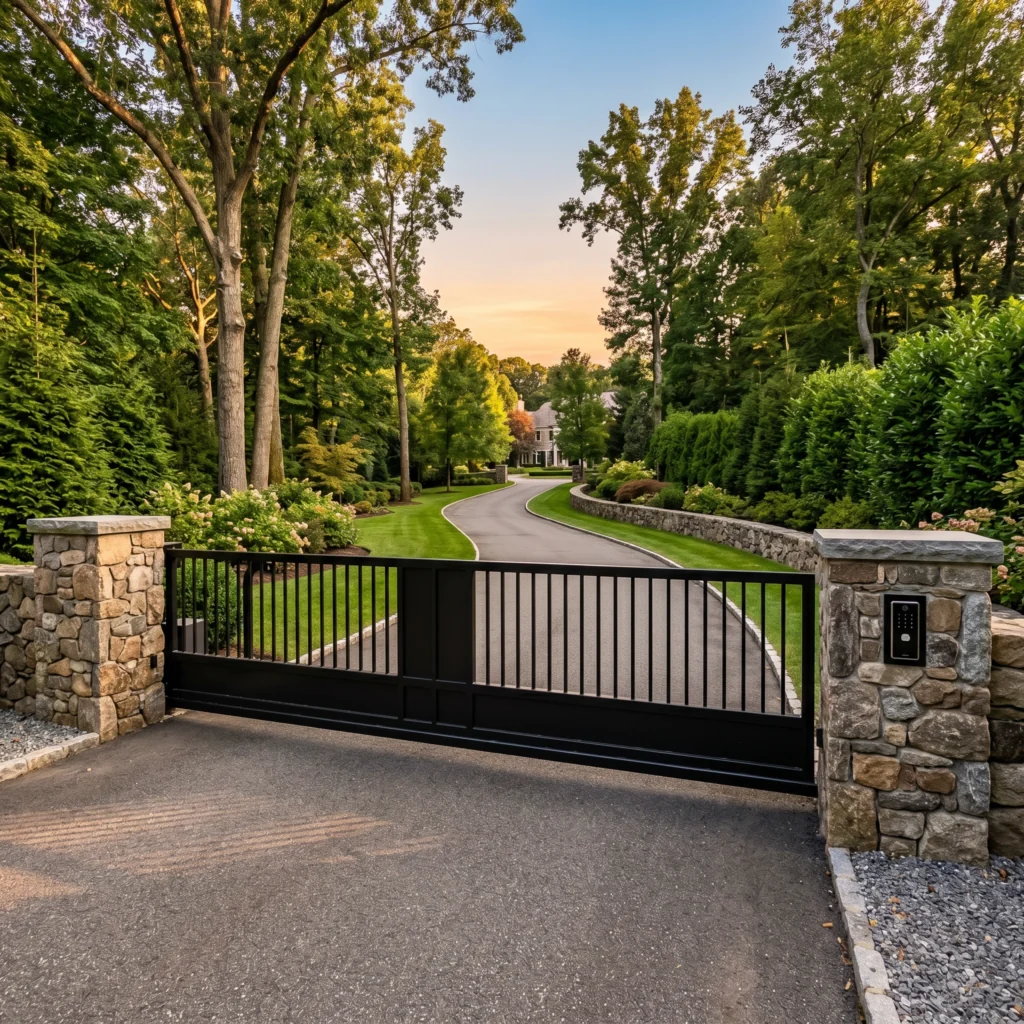
Homeowners with an existing electric gate should check compatibility before selecting a biometric lock. Similarly, those planning a new custom electric gate installation should do the same. Most modern electric gate operators accept external access control inputs, and fingerprint smart lock devices qualify as such inputs.
The standard connection method is a dry-contact input on the gate’s control board. When the lock authenticates a valid fingerprint, it sends a brief signal through this connection. That signal then triggers the gate motor to cycle open, just as a remote or keypad would. Most existing gate systems do not require a specialized model. A technician can therefore retrofit the control board to accept this type of input with the right wiring.
For properties getting a custom electric gate from the ground up, integrating a biometric lock at the planning stage is ideal. That approach produces the cleanest and most reliable result. Specifically, the installer can decide the wiring route, mounting position, power supply, and control board configuration in advance. This avoids complications common to retrofit situations. In particular, a gate whose original design lacked biometric access creates more work to adapt.
At any stage, confirming compatibility between the lock and the gate operator is worthwhile. Always do this before purchasing to avoid surprises after the fact.
What Should Homeowners Check Before Installing a Biometric Gate Lock?
Not every fingerprint smart lock suits outdoor gate use. As a result, selecting the right model requires attention to a few specific factors before making a purchase.
Weather Resistance Rating
Gate locks face sun, rain, dust, and temperature changes year-round. Therefore, a lock for exterior use should carry an IP65 or IP66 rating at minimum. This rating confirms the device resists dust fully and handles direct water exposure. Locks without adequate weather protection may work initially but will degrade faster in outdoor conditions.
Power Source and Battery Life
Many gate-rated biometric locks run on standard batteries. While this is straightforward to manage, it requires periodic replacement. Some models, however, support hardwired power or include a backup USB or solar charging input. High-use gates benefit particularly from these alternatives. Checking the power setup before purchasing also helps avoid unexpected lockouts from a depleted battery.
User Capacity
Entry-level biometric locks may cap at 20 to 30 stored fingerprint profiles. For a single-family home, this is typically sufficient. A commercial property or multi-unit building, however, needs a model with higher user capacity. The same applies to any site where a local gate company manages access for multiple service personnel.
Sensor Reliability
Look for a lock that specifies its false rejection rate in the technical documentation. A low false rejection rate means the system recognizes authorized users quickly and consistently. Furthermore, higher-grade sensors perform more reliably in varying light conditions. They also handle minor variations in fingerprint presentation well, such as a slightly damp finger or a recently healed cut.
When Should You Work With a Gate Professional on This Installation?
Installing a fingerprint smart lock on a standalone pedestrian gate is manageable for a confident homeowner. In this case, the gate does not need a motor for this to work. Integrating the lock with a powered electric gate system, however, is a different matter. The process involves wiring, voltage matching, and control board configuration. As a result, a professional brings the experience to handle these steps correctly.
A local gate company with experience in access control systems can evaluate an existing gate setup. They can also confirm that a chosen biometric lock suits the gate operator and complete the integration properly. Additionally, they test the full access cycle from fingerprint scan to gate movement before finishing the job. That verification step ensures the system performs as intended.
If the property does not yet have a gate, professional involvement from the planning stage delivers the best result. A custom electric gate with integrated biometric access requires coordinated decisions. These include motor capacity, wiring layout, control board type, and lock mounting position. Therefore, bringing in an experienced technician early avoids costly adjustments later.
For most property owners, the right fingerprint smart lock paired with a professional installation delivers reliable results. Ultimately, the upgrade performs well for years without unexpected maintenance issues. Contact Royal Garage Door & Gate Services INC to discuss biometric gate access. They can help you find the best option for your specific setup.
Why Customers Trust Royal Garage Door & Gate Services INC
Royal Garage Door & Gate Services INC maintains a strong and consistent local presence across trusted online business directories. As a result, this ensures accurate and reliable information for every customer. The company holds verified listings on respected platforms such as MapQuest and Chamber of Commerce. Additionally, other established local listing networks also feature the business.
These trusted platforms reinforce credibility and confirm business details. Furthermore, they support customers searching for dependable fingerprint smart lock installation and gate services.
Royal Garage Door & Gate Services INC
Address: 6832 Amigo Ave, Reseda, CA 91335
Phone: (323) 744-3883
Email: [email protected]
Service Hours: Sunday to Thursday: 24 hours | Friday: 12am to 2:30pm | Saturday: Closed
Contact Royal Garage Door & Gate Services INC to schedule a gate security consultation. Learn more about fingerprint smart lock integration for your electric gate system.