Quick Answer
Barrier arms are optimized for fast traffic control. Sliding gates provide a physical perimeter closure but usually move more slowly and require a larger moving structure. High-volume properties sometimes use both: barrier arms for daily credentialed traffic and a sliding gate for after-hours perimeter closure.
The choice depends on security goals, traffic volume, lane design, pedestrian separation and how quickly vehicles need to process.
Barrier Arm Strengths
Barrier arms can offer:
- fast open/close;
- high cycle capability in many commercial models;
- low moving mass;
- clear lane control;
- easy integration with ticketing/RFID/LPR.
They are common in parking applications.
Barrier Arm Limitations
A barrier arm does not provide the same physical perimeter closure as a full-height sliding gate.
It may not stop:
- pedestrians;
- motorcycles depending on layout;
- determined vehicle entry.
It is traffic control, not a complete security fence.
Sliding Gate Strengths
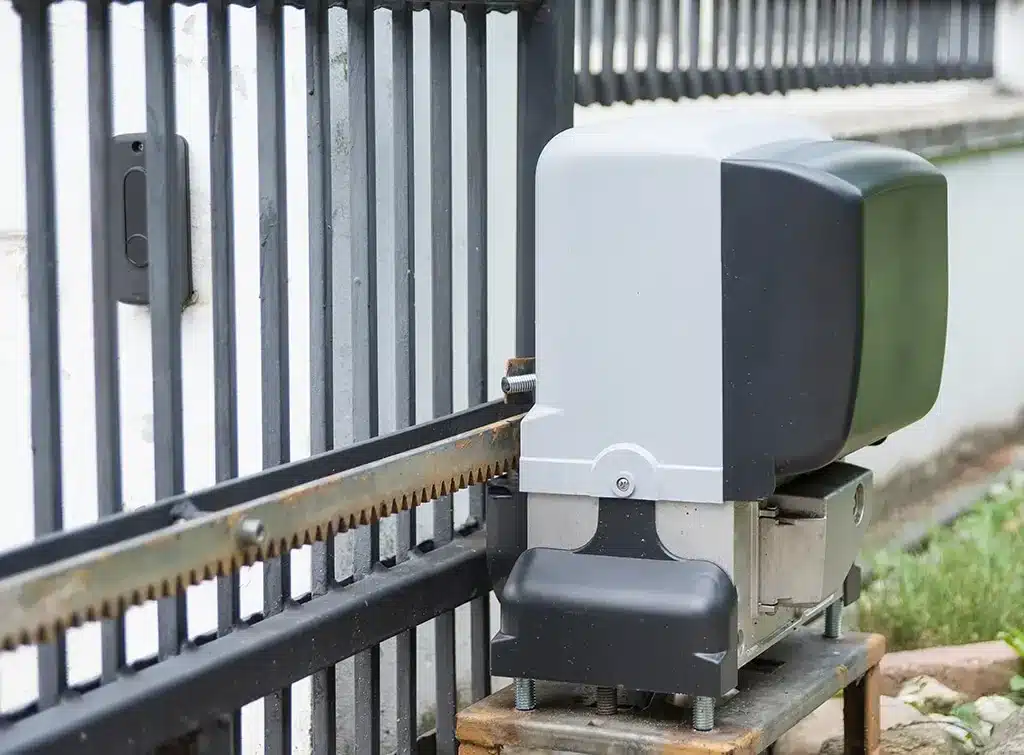
A sliding gate can close the full opening.
It supports:
- perimeter security;
- visual/privacy design;
- after-hours closure.
But a large sliding gate needs:
- run-back;
- rollers/track or cantilever support;
- more travel time;
- heavier operator.
Throughput
If one sliding gate takes many seconds to fully open/close, processing one vehicle at a time can create queues.
Barrier arms can cycle faster.
A hybrid design may keep the sliding gate open during staffed/high-volume periods while barrier arms control individual vehicles.
This should be engineered with safety and policy.
Tailgating at Barrier and Sliding Entrances
A barrier arm can close between vehicles more quickly, which may deter tailgating.
But closing too aggressively increases strike risk.
Use proper vehicle detection and manufacturer logic.
No gate configuration guarantees zero tailgating.
Pedestrian Separation
Barrier arms can be difficult for pedestrians to interpret.
A property should provide a separate pedestrian route rather than allowing people to walk around the arm through vehicle lanes.
Security Level
Ask what the entrance is trying to stop.
- casual unauthorized vehicle;
- resident credential abuse;
- after-hours trespass;
- high-security vehicle attack.
A barrier arm fits some of these but not all.
High-security anti-ram systems are a separate category.
Space
Sliding gates need lateral run-back.
Barrier arms need vertical/side clearance for the boom.
This can make barrier arms easier on constrained sites.
Barrier and Sliding-Gate Maintenance
Barrier arms have:
- boom hardware;
- springs/counterbalance;
- operator;
- loops/sensors.
Sliding gates have:
- gate structure;
- rollers;
- guides;
- track/cantilever hardware;
- operator.
Compare maintenance scope, not just motor complexity.
Hybrid Architecture
A common layered concept:
- resident RFID/LPR;
- barrier arm cycles per vehicle;
- full sliding gate open during normal hours;
- full gate closes after hours.
This can reduce cycles on the heavy gate.
The exact safe sequence needs manufacturer/integrator design.
Combined Systems Need Clear Sequencing
If a barrier arm and sliding gate occupy the same lane, define which device moves first and which controls the closing decision.
A poorly coordinated setup can create situations where:
- barrier opens but slide gate is still closed;
- slide gate begins closing while barrier admits vehicle;
- loops belong to one controller but not the other.
The integrator should document the sequence.
Weather and Wind
Barrier arms have relatively low wind area compared with full gates, but long booms can still be affected by wind and balance. Use the manufacturer’s arm length, accessory and wind restrictions.
A solid sliding gate may remain the dominant wind load at the entrance.
Night/After-Hours Policy
Hybrid sites often operate differently after hours. For example, the full slide gate may close and cycle for each authorized vehicle at night.
If so, calculate night cycle demand and ensure the heavy gate remains suitable.
What to Ask Vendors
- Which device is the primary security boundary?
- How many cycles will each operator perform?
- Which loops protect which movement?
- What happens if barrier is struck?
- Can the full gate operate if barrier controller fails?
- How is emergency access handled?
These questions expose whether the architecture is truly layered or merely multiple devices wired together.
Compare Throughput, Security and Physical Footprint
Barrier arms usually open and close faster and use less physical travel area than a full sliding gate, which can make them well suited to high-volume credentialed vehicle lanes. A sliding gate provides a stronger physical perimeter when closed but takes longer to clear the opening and needs side room for the gate leaf.
The choice therefore depends on what the entrance is expected to do. A staffed parking lot may use a barrier arm for traffic control, while a perimeter-sensitive industrial site may require a full sliding gate or a layered combination.
Hybrid Entrances Are Common
Some properties use a sliding gate for after-hours perimeter security and a barrier arm for daytime traffic management. That arrangement can reduce the number of heavy-gate cycles while preserving a more substantial closure when needed.
The controls must be coordinated so that vehicles are not trapped between devices and so emergency access, loops and safety zones remain clear. A layered entrance is a system design project, not simply two operators installed next to each other.
Bottom Line
Use barrier arms for fast lane control and full sliding gates for perimeter closure.
For high-volume entrances, a layered system can separate those jobs instead of forcing one heavy gate to perform every traffic-control cycle.