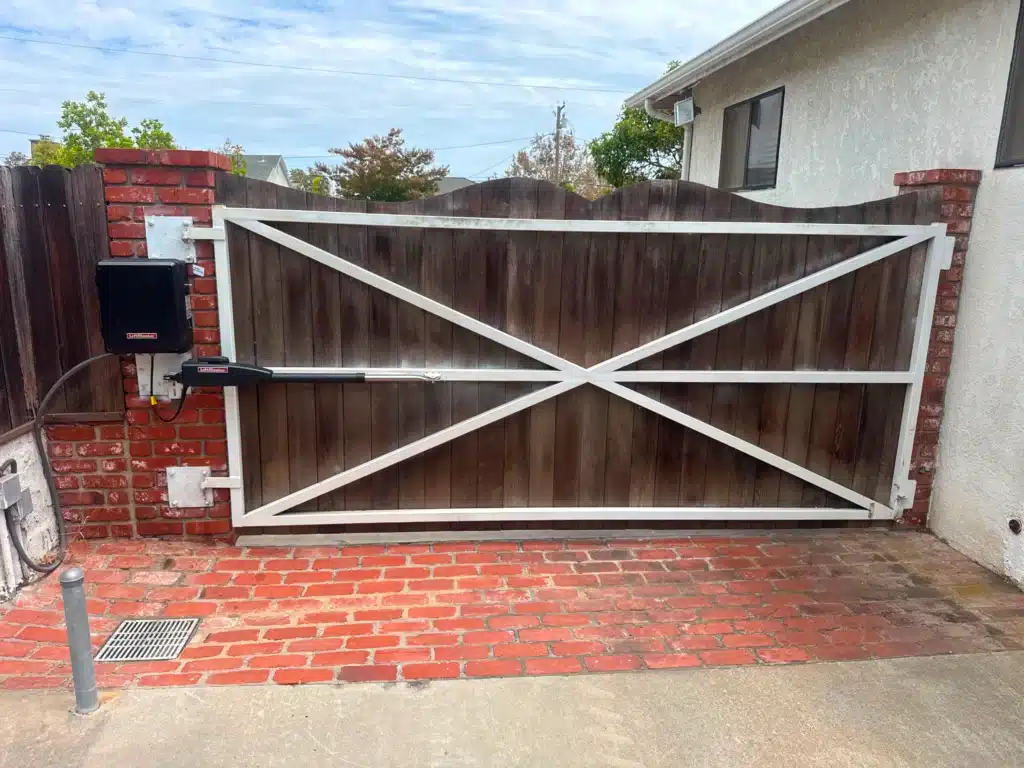
Quick Answer
A gate motor should never be selected or diagnosed in isolation from the gate it moves. Operator choice depends on gate type, weight, length, geometry, wind exposure, traffic level, power availability, access-control needs and safety requirements. Troubleshooting should begin by confirming that the gate moves freely, the operator has stable power, safety devices are healthy, and the control system is issuing the correct command.
A motor that hums but does not move may be stalled by mechanical resistance or may have a drive, capacitor, gearbox or motor problem. A motor that runs while the gate stays still often points to a disconnected or failed mechanical drive. A gate that becomes slow can indicate drag, low voltage, weak batteries, overheating, operator wear or an operator that was undersized from the beginning. Control boards, limit systems and position feedback can create motor-like symptoms even when the motor itself is functional.
The central decision is not “Which brand is best?” but “Which operator is correctly matched to this gate and this usage?”
In this guide
- Motor versus operator: the distinction matters
- The main types of gate operators
- AC, DC and hydraulic operators fail in different ways
- How to size a gate operator correctly
- Why a gate motor hums but the gate does not move
- Why the motor runs but the gate does not move
- Why a gate operator becomes slow or weak
- Motor failure or control-board failure?
- Diagnostic codes are useful, but they are not the diagnosis
- Limit switches, encoders and position problems
- Batteries, chargers and solar power
- Why one side of a dual swing gate stops working
- Overheating, repeated shutdowns and high-cycle use
- Parts availability and obsolescence change the repair decision
- Maintenance, service life and warranty should be evaluated together
- Repairing an older operator versus replacing it
- Choosing among LiftMaster, DoorKing, FAAC, Ramset, All-O-Matic, Eagle and BFT
- What a gate-operator replacement estimate should include
- Related Royal Gates resources
Motor versus operator: the distinction matters
People often use “gate motor,” “gate opener” and “gate operator” as if they mean exactly the same thing. In practice, the motor is only one component inside the operator system. The operator may also include a gearbox, drive chain or arm, control board, limit system, battery charger, receiver, relays, safety inputs and communication hardware for dual-gate operation.
That distinction matters during repair. If the control board sends no output, installing a new motor will not solve the problem. If a slide gate has a broken chain, the motor can run normally while the gate remains stationary. If a swing gate is binding, a healthy motor may stall or overheat. If the limit system is incorrect, the operator may stop early or continue driving after the gate reaches its physical position.
A complete diagnosis separates four questions:
- Is the gate mechanically free and correctly aligned?
- Is the operator receiving proper power and commands?
- Is the drive system transferring motor force to the gate?
- Is the control system correctly reading limits, position and safety inputs?
Only then can the failed component be identified with confidence.
The main types of gate operators
Different gate designs create different mechanical demands, so there is no universal operator.
Slide gate operators
Slide operators move a gate horizontally along a track or cantilever system. They commonly use chain-driven or rack-driven mechanisms. Selection depends on gate weight, gate length, travel speed, cycle demand, site geometry and whether the system is residential, commercial or restricted-access.
A slide gate that binds on the track can put severe load on the operator. Roller condition, track alignment and gate balance should be checked before electrical parts are blamed.
Swing gate operators
Swing gates rotate around hinges. Operators may use articulated arms, linear actuators, underground drives or other mechanisms. Gate width, hinge geometry, wind load and the distance from hinge to operator mounting points all affect the force required.
A long, solid gate leaf can create substantial wind load even if its static weight is within an operator’s published limit. That is why operator sizing cannot rely on weight alone.
Hydraulic operators
Hydraulic operators are common in applications that need smooth movement, high force or specific mounting configurations. Diagnosis can involve hydraulic pressure, seals, valves and fluid condition in addition to electrical controls. A hydraulic operator that loses force or leaks requires a different diagnostic path from an electromechanical arm.
Barrier and traffic-control operators
Barrier arms are designed for vehicle-flow control rather than as substitutes for full security gates. Commercial parking, campuses and controlled lanes may use barrier operators where speed and cycle volume matter more than perimeter closure.
Underground operators
Underground swing operators preserve a clean visual appearance because the drive mechanism is installed below grade near the hinge. Drainage and water management become critical. A beautiful installation can become a maintenance problem if the operator box routinely collects water.
AC, DC and hydraulic operators fail in different ways
Not every operator uses the same drive architecture, so the diagnostic path should match the actual equipment.
An AC operator may use a motor, contactor or relay logic, gearbox and, on some motor designs, a start or run capacitor. A failed capacitor can create a hum-without-starting symptom, but that diagnosis should not be assumed on every operator because many modern systems use different motor and control designs.
DC operators add batteries, chargers and power-conversion electronics to the system. A DC operator can have normal utility power at the property while still failing because the battery bank is weak, the charger is not recovering it, or voltage collapses under load. Battery condition therefore has to be tested under operating demand, not judged only by an unloaded voltage reading.
Hydraulic operators add another set of possible failure points: hydraulic fluid condition, leaks, seals, valves, pumps, pressure and mechanical actuator condition. A hydraulic swing gate can appear electrically healthy while losing movement because the hydraulic system cannot generate or hold the required force.
The practical rule is simple: identify the operator model and architecture before diagnosing by symptom alone.
How to size a gate operator correctly
The most expensive operator is not automatically the right operator, and horsepower is not the only sizing variable. Manufacturer specifications commonly include maximum gate weight, maximum gate length, application class, duty cycle and environmental or power limitations.
A professional sizing review should consider:
- Gate type: slide, swing, cantilever, overhead, barrier or specialty.
- Gate weight and length.
- Hinge, wheel, roller and track condition.
- Wind exposure, especially on solid or partially solid swing gates.
- Slope and geometry.
- Expected cycles per day and peak traffic periods.
- Residential, commercial, industrial or restricted-access use.
- Desired opening speed.
- AC, DC, battery backup or solar power requirements.
- Dual-gate coordination.
- Access-control integrations.
- Required monitored entrapment-protection devices.
- Local environmental exposure, including heat, dust, irrigation and coastal corrosion.
Commercial examples show why this matters. LiftMaster’s SL3000UL, for example, is designed as a high-traffic commercial slide operator with a continuous-duty motor. DoorKing’s 6300 commercial swing operator is also specified for continuous operation in appropriate applications. All-O-Matic publishes operator-specific gate-weight, gate-length and duty-cycle limits. These specifications are not interchangeable, and the final selection should follow the current manufacturer documentation for the exact model.
Why a gate motor hums but the gate does not move
A hum means the system may be energizing the motor, but it does not prove the motor is able to start or that the gate is mechanically free.
Possible causes include:
- Gate binding or excessive mechanical resistance.
- Failed start/run capacitor on an applicable AC motor.
- Locked or damaged gearbox.
- Seized bearing or drive component.
- Low voltage under load.
- Motor winding or internal motor failure.
- Incorrect clutch or drive condition on systems that use one.
The first step should be mechanical. If the gate is difficult to move in the manufacturer-approved manual mode, repair the gate hardware before condemning the motor. Repeatedly energizing a stalled operator can create heat and additional damage.
Why the motor runs but the gate does not move
This symptom points more strongly to the drive connection between the motor and the gate. A chain can break or come off a sprocket. A coupling can fail. A drive arm can disconnect. A gearbox can fail internally. A slide gate can have a motor spinning while the transfer mechanism no longer moves the gate.
Listen and observe from a safe position. If the motor clearly reaches operating speed but no gate movement occurs, shut down the system and inspect the drive path rather than continuing to cycle the operator.
Why a gate operator becomes slow or weak
Slow movement can come from the motor, but it can also come from everything around the motor.
Common causes include:
- Increasing mechanical drag.
- Worn wheels, rollers or hinges.
- Low AC voltage or voltage drop.
- Weak batteries in a DC or backup system.
- Charging-system problems.
- Overheated electronics or motor.
- Worn gearbox or drive parts.
- Heavy wind load.
- Incorrect operator sizing.
- Control settings that intentionally limit speed.
The pattern helps. A gate that is slow only after many cycles may be experiencing heat or power limitations. A gate that is always slow in one direction may have mechanical geometry or balance issues. A gate that slowed gradually over months may be showing cumulative wear.
Motor failure or control-board failure?
This is one of the most important diagnostic distinctions because both can produce a non-moving gate.
A technician can separate the two by checking whether the board receives the command, whether safety inputs allow travel, whether the board sends the expected motor output, whether the motor draws current, and whether the operator reports diagnostic codes.
Control-board faults may also affect several functions at once. For example, remotes, limits and accessory outputs can behave abnormally even though the motor itself is intact. Conversely, a board may command movement correctly while a failed motor or drive never produces useful motion.
Replacing the board because “the gate does nothing” is no more reliable than replacing the motor for the same reason. Measurement is better than guessing.
Diagnostic codes are useful, but they are not the diagnosis
Modern operators often provide LEDs, alarms, displayed fault codes, event logs or software diagnostics. These can quickly narrow the search to a monitored safety input, limit fault, battery condition, communication problem or control-board error.
A code should still be interpreted in context. A “force” or obstruction-related event may be caused by a dragging gate rather than an electronic problem. A safety-device code may originate in damaged field wiring rather than the sensor itself. A low-voltage code can be caused by a battery, charger, undersized conductor, loose connection or supply problem.
Before replacing parts, record the exact code, the operating direction, the point in travel and the conditions under which the code appears. Clearing the code without finding the cause destroys diagnostic evidence.
Limit switches, encoders and position problems
Every automatic gate needs a way to know when to stop. Older operators may use mechanical or magnetic limit switches. Modern systems may use encoders, position sensors or electronic limit learning.
Limit-related symptoms include:
- Gate stops before reaching fully open or fully closed.
- Gate travels too far and hits a physical stop.
- One leaf of a dual gate finishes at the wrong time.
- Operator loses its learned position after a power or control event.
- Gate reverses or faults near the end of travel.
A limit problem can be mistaken for a motor problem because the motor appears to “give up” at a certain point. The difference is repeatability. If the gate always stops at the same learned or physical position, limits and position feedback deserve early attention.
Batteries, chargers and solar power
DC operators, battery-backup systems and solar installations add another diagnostic layer. A battery can have enough voltage at rest but collapse under load. A charger can appear powered but fail to restore the battery bank. A solar panel can be correctly sized for average conditions yet underperform because of shade, dirt, orientation, damaged wiring or increased gate usage.
A solar gate should be designed as an energy system, not simply as a panel attached to an operator. Daily cycles, battery capacity, solar input, accessory power consumption and seasonal sunlight all matter.
For remote properties, solar can be an excellent option when trenching AC power is impractical. For high-cycle sites, the energy budget becomes much more demanding. Manufacturer solar sizing guidance should be used for the exact operator and site conditions.
Why one side of a dual swing gate stops working
A dual gate can fail because of a problem local to one operator or because the pair can no longer communicate correctly.
The diagnostic checklist includes:
- Power at both control boxes/operators.
- Primary-secondary communication wiring or wireless link.
- Secondary motor and drive condition.
- Limits or learned position on each leaf.
- Safety-device inputs shared by the system.
- Overlap or bi-part sequencing settings.
- Mechanical drag on one gate leaf.
LiftMaster, for example, offers dual-gate communication and bi-part delay functions on certain operator systems. Other manufacturers use different architectures. The correct troubleshooting sequence follows the model-specific manual rather than assuming every dual gate is wired the same way.
Overheating, repeated shutdowns and high-cycle use
A gate operator that works in the morning but shuts down after repeated traffic may not have an isolated electrical defect. The site may be demanding more cycles than the operator is designed to handle, the motor may be overheating because the gate is dragging, or the power system may be unable to support sustained use.
This is where residential and commercial operator selection diverge. A residential driveway that cycles a few dozen times per day has a different duty requirement from an apartment complex, warehouse, school or parking facility. Manufacturers publish duty classifications and continuous-duty models specifically because cycle load changes operator design.
If an operator is repeatedly overheating, the repair decision should include a sizing review. Replacing a failed motor with an identical undersized motor simply restarts the same failure cycle.
Parts availability and obsolescence change the repair decision
Operator age matters less than supportability. An older operator can remain a good repair candidate when the gate is mechanically sound, the operator is correctly sized, safety requirements can be met, and critical replacement parts remain available.
The economics change when a control board, gearbox, proprietary sensor or other essential component is discontinued. The same is true when technical documentation is unavailable or when a replacement part would leave several other aging components close to failure.
A good repair-versus-replacement review should ask:
- Is the failed component still supported by the manufacturer?
- Are safety devices compatible with the current operator?
- Can replacement boards or accessories be configured without creating unsupported workarounds?
- Are batteries, receivers and communication modules still serviceable?
- Would a new operator reduce a recurring problem caused by incorrect sizing or duty cycle?
- How costly would another outage be if a second obsolete component fails?
This is especially important at commercial and multifamily properties where waiting several days for a discontinued part may cost more than a planned replacement.
Maintenance, service life and warranty should be evaluated together
There is no universal lifespan for a gate operator. Service life depends on cycle count, gate condition, environment, operator sizing, maintenance, power quality and how often the system is forced to work against mechanical resistance.
Preventive maintenance should therefore focus on the loads that shorten operator life: dragging gates, loose drive components, worn hinges or rollers, water intrusion, battery degradation, heat, corrosion and repeated safety faults. Fixing those conditions protects the replacement operator as well as the existing one.
When comparing repair with replacement, warranty should be evaluated as part of the decision rather than as a headline number. Confirm what the manufacturer covers, what the installer covers, whether labor is included, and whether commercial usage changes the warranty terms. The proposal should also state what routine maintenance is expected to keep the system operating correctly.
Repairing an older operator versus replacing it
Older operators are not automatically bad. A well-built operator with available parts, correct sizing and a safe gate can often be repaired economically. Replacement becomes more attractive when several conditions appear together:
- Critical parts are discontinued or difficult to source.
- The operator is incorrectly sized for the gate or traffic.
- Safety-device compatibility is limited.
- Control-board failures are recurring.
- The gearbox or motor has major wear.
- The property needs modern access-control features that the old system cannot support reliably.
- Downtime from repeated failures costs more than replacement.
Manufacturer support status matters. DoorKing and other manufacturers maintain documentation for discontinued models, but documentation availability does not mean every replacement part remains practical indefinitely. A good estimate should distinguish between “repairable today” and “supportable for the next several years.”
Choosing among LiftMaster, DoorKing, FAAC, Ramset, All-O-Matic, Eagle and BFT
Royal Gate Services works with several major operator brands, but a useful brand comparison should not be reduced to a winner-and-loser list. Each manufacturer has different strengths, product families, support ecosystems, commercial options and legacy installations throughout Southern California.
The right comparison asks:
- Does the manufacturer offer an operator correctly sized for the gate?
- Is the required duty cycle supported?
- Are safety accessories readily available and compatible?
- Does the system support the access-control platform the property uses?
- Are replacement parts and technical documentation available locally?
- Does the installer have experience with the specific product family?
- Is the operator appropriate for the environment and mounting geometry?
LiftMaster, DoorKing, FAAC, Ramset, All-O-Matic, Eagle and BFT all offer different operator families, control architectures and application limits. Brand matters most when it affects sizing, parts availability, technical support, compatibility and the site’s real operating requirements.
What a gate-operator replacement estimate should include
A replacement estimate should contain more than the operator model and price. It should document the gate type and condition, why the selected operator is appropriate, required electrical work, safety devices, mounting changes, access-control compatibility, battery or solar requirements, manual release, permits or code considerations where applicable, and what will happen to existing accessories.
For a dual gate, it should also address whether both operators should be replaced together and how synchronization will be handled. For a commercial site, it should address cycle demand and expected downtime during installation.
The goal is to prevent a new operator from inheriting the old system’s mechanical, electrical or safety problems.
Pro Tip: size the system for real use, not brochure maximums alone
Published maximum weight and length are important, but a gate can still be a poor application if wind, slope, poor geometry, high cycles or mechanical drag push the system beyond normal conditions. Treat manufacturer limits as application boundaries, then account for the real gate, real site and real traffic.
Related Royal Gates resources
Bottom Line
Gate motors fail, but many “motor problems” actually begin with mechanical drag, power, controls, limits, safety inputs or a failed drive connection. Diagnose the system before replacing the most expensive component.
For new operator selection, match the operator to the gate type, weight, length, wind exposure, geometry, traffic level, power source, safety requirements and access-control system. Residential, commercial and industrial applications should not be treated as the same duty environment.
The best operator decision combines correct application sizing, serviceability, safety compatibility and long-term parts support rather than choosing a brand name in isolation.
Frequently Asked Questions
What is the difference between a gate motor and a gate operator?
The motor produces motion, while the operator is the larger system that may include the motor, gearbox, control board, limits, receiver, battery charger, safety inputs and drive hardware.
Why does my gate motor hum but not move?
The motor may be stalled by mechanical resistance, low voltage, a failed capacitor on applicable motors, a damaged gearbox or an internal motor problem. The gate should be checked for free movement before the motor is replaced.
Why does the motor run but the gate stay still?
A broken or disconnected chain, coupling, drive arm, gearbox or other transfer component can allow the motor to run without moving the gate.
How do I know if the control board or motor failed?
A technician checks whether the board receives the command, whether safety inputs permit movement, whether the board sends output to the motor, and whether the motor responds under the correct electrical conditions.
Why is my gate operator getting slower?
Mechanical drag, low voltage, weak batteries, charging problems, operator wear, heat or incorrect sizing can all reduce speed.
Can a residential operator be used on a commercial gate?
Only if the manufacturer rates that specific operator for the application and cycle demand. High-traffic properties often require commercial or continuous-duty equipment.
Is solar power reliable for an automatic gate?
It can be when the operator, battery bank, panel size, site sunlight and expected daily cycles are designed as one system. High accessory loads and heavy traffic increase the required energy budget.
Should I replace both operators on a dual gate at the same time?
Not automatically. The decision depends on age, compatibility, control architecture, condition and whether a new primary operator can communicate safely and reliably with the existing secondary system.